Article: Why We Use Stabilized Turquoise in Bridal Rings
Why We Use Stabilized Turquoise in Bridal Rings
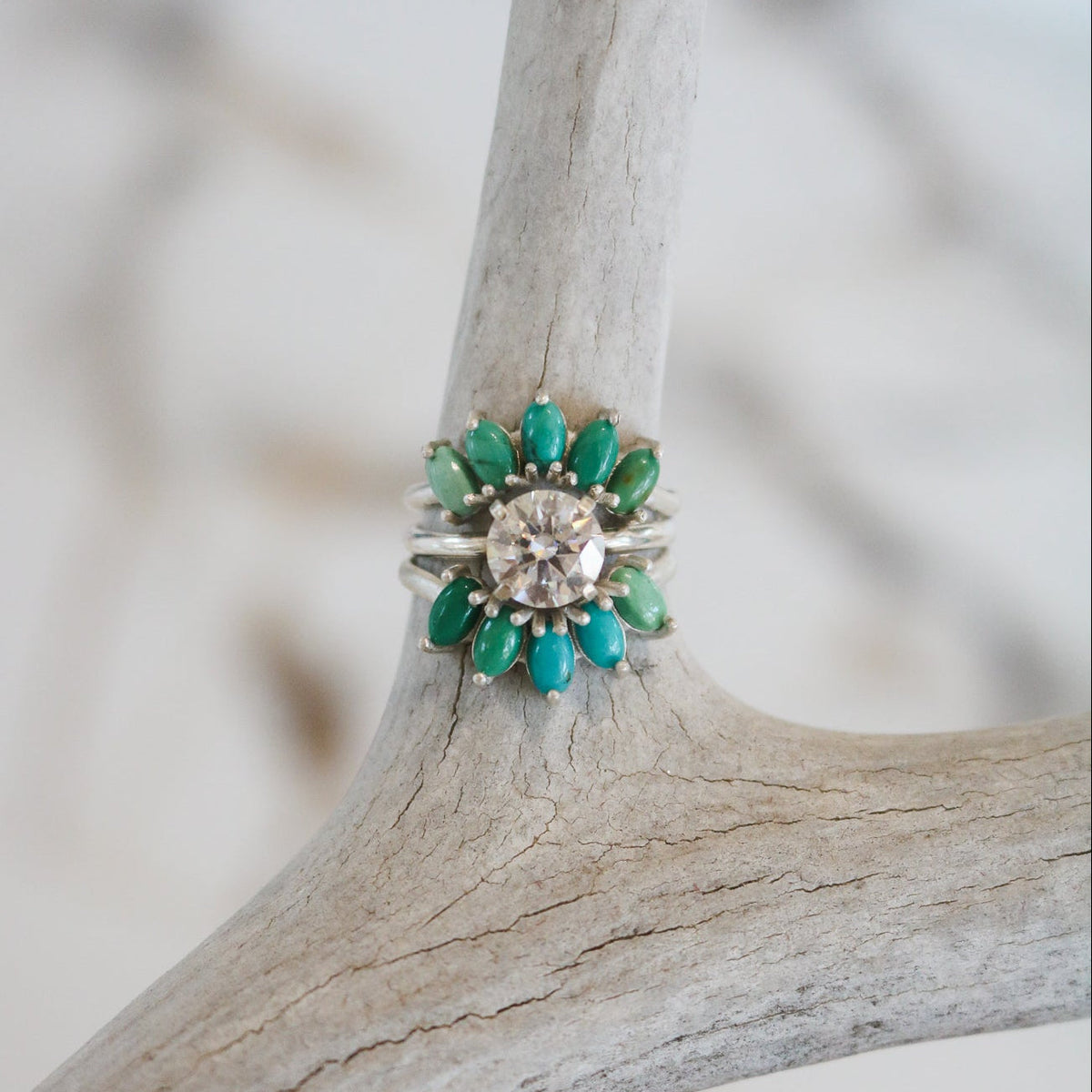
The little details matter. Here’s why the turquoise in our delicate contour bands and accent rings is carefully selected for both beauty and durability.
When you shop for turquoise jewelry, it’s easy to focus on the color. But when it comes to the tiny turquoise stones set into our contour bands, wedding rings, and bridal accent rings, there’s much more to consider than how beautiful a stone looks.
Some of the turquoise in these designs measures just 1–4 millimeters. At that scale, choosing the right material is essential to creating a finished piece that is beautiful, wearable, and worthy of becoming part of your story.
That’s why we use stabilized turquoise with minimal visible matrix in these delicate designs.
Why Stone Size Matters
Turquoise is a naturally occurring mineral, but not every piece of turquoise has the same density, porosity, or structural strength. Some material is compact and holds together well when cut. Other material can be porous, brittle, or prone to crumbling during the cutting and shaping process.
When working with a larger turquoise cabochon, a lapidary has more material to work with. Tiny accent stones leave very little room for error.
A stone measuring only a few millimeters must be carefully cut, shaped, polished, and fitted into its setting. At this scale, even a small fracture or weak area can compromise the finished stone.
The smaller the stone, the more important it becomes to select material that can withstand the demands of precision cutting and setting.
What Is Stabilized Turquoise?
Stabilized turquoise is genuine turquoise that has been treated, typically through the introduction of a clear polymer or resin, to improve its structural integrity and reduce its porosity.
The stabilization process helps bind the material together, making suitable turquoise easier to cut, polish, and use in jewelry. It can also help reduce the stone’s susceptibility to absorbing oils and other substances that may affect its appearance.
Stabilization does not mean the stone is imitation turquoise. The turquoise itself is genuine mineral material; the treatment helps make it more practical for jewelry use.
For our delicate bridal designs, this added stability is especially valuable. We want to work with turquoise that can be fashioned into these tiny shapes without unnecessarily sacrificing material during the cutting process.
Why We Choose Turquoise With Less Matrix
Matrix refers to the darker veins, webbing, or patches of surrounding rock often visible in turquoise. It can create beautiful contrast and is a beloved characteristic of many Southwestern turquoise stones.
However, for our smallest bridal accent stones, we look for turquoise with minimal visible matrix.
Matrix is not inherently a sign of weakness, and its presence alone doesn’t determine a stone’s durability. The concern is the overall structure and consistency of the material. When turquoise contains irregular inclusions or areas with differing physical properties, those characteristics can complicate the cutting of very small stones.
Selecting more consistent turquoise with less visible matrix helps us achieve the clean, cohesive appearance these delicate designs call for while allowing us to work with material suited to such small cuts.
It’s a practical choice driven by the scale of the design, not a judgment on the beauty or value of matrix-rich turquoise.
Does Stabilized Mean Less Special?
Not at all.
Turquoise has been treasured for generations, and its natural beauty comes in countless shades, patterns, and textures. Stabilization is one of the established methods used by the jewelry industry to prepare suitable turquoise for wearable jewelry.
We believe craftsmanship means understanding the material you’re working with and choosing it thoughtfully for its intended purpose.
A substantial turquoise centerpiece and a row of tiny accent stones have different requirements. The material best suited to one application may not be the best choice for another.
For our contour bands and accent rings, stabilized turquoise allows us to create delicate designs with carefully fitted stones and the distinctive color we love.
A Note About Caring for Your Turquoise Bridal Jewelry
Although stabilization improves the durability of turquoise, it does not make the stone indestructible.
Turquoise is still softer and more chemically sensitive than many of the other gemstones used in bridal jewelry. Household cleaning products, silver dips, harsh chemicals, steam cleaners, and ultrasonic jewelry cleaners can damage turquoise or affect its appearance.
To care for your ring:
- Remove it before using household cleaning products or handling chemicals.
- Avoid jewelry cleaning solutions intended for diamonds or other gemstones unless they are specifically confirmed safe for your turquoise.
- Never use steam or ultrasonic cleaners on turquoise jewelry.
- Wipe the ring gently with a soft, slightly damp cloth and dry it thoroughly.
- Remove your ring during activities that could expose it to hard impacts, abrasion, or unnecessary stress.
We also recommend removing turquoise rings before swimming, bathing, exercising, or doing household chores. Taking these precautions helps protect the turquoise and the surrounding settings.
At Prairie Sky Jewelry Co, we believe the details that make a piece beautiful should also be considered in how it is made.
Our choice of stabilized turquoise with minimal visible matrix for delicate bridal accent stones reflects that philosophy. These tiny stones require careful selection and precision, and the material we choose is part of that process.
The result is turquoise jewelry designed to bring color, character, and a touch of the Southwest to your bridal stack.