Diamond vs. Moissanite: What's the Difference?
Diamond and moissanite are often compared for one simple reason: at first glance, they can look remarkably similar.
Both are bright, colorless gemstones. Both are durable enough for everyday wear. Both can be cut into the same shapes and used in everything from a simple solitaire to an elaborate engagement ring.
But they are not the same stone.
Moissanite is not a diamond, and it is not a lab-grown diamond. It has its own chemical composition, optical properties, durability, and character.
For some people, that distinction matters deeply. For others, what matters most is how the stone looks, how it performs, and what it allows them to create within their budget.
Neither choice needs to be defended.
The better question is simply: what are you looking for in your ring?
What Is a Diamond?
A diamond is made of carbon arranged in a crystalline structure.
Natural diamonds formed within the earth over billions of years. Lab-grown diamonds are created in controlled environments using processes that replicate the conditions necessary for diamond growth.
Their origins are different, but both natural and lab-grown diamonds are diamonds.
They share the same essential chemical composition, crystal structure, hardness, and many of the physical properties that define diamond.
If you would like to understand the differences between those two options, you can read our guide to Lab-Grown Diamonds vs. Natural Diamonds.
What Is Moissanite?
Moissanite is a gemstone made of silicon carbide.
Natural moissanite was first discovered in a meteor crater by French scientist Henri Moissan in the late 19th century. Naturally occurring moissanite is exceptionally rare, so virtually all moissanite used in modern jewelry is created in a laboratory.
Although moissanite is lab-created, it should not be confused with a lab-grown diamond.
They are entirely different materials.
Moissanite has its own crystal structure and optical properties, which is why it reflects light differently from diamond.
The Biggest Difference: How They Sparkle
This is often where people begin to notice the difference.
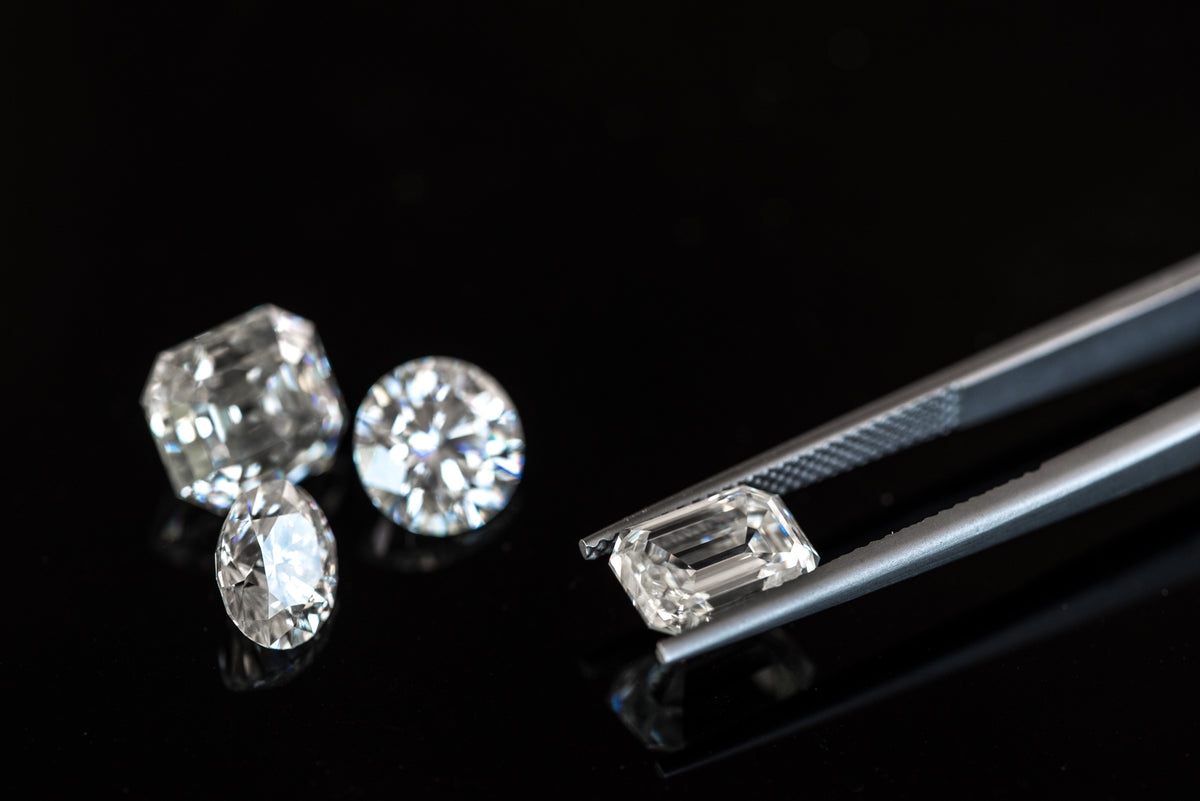
Diamonds and moissanite both have exceptional brilliance, but they handle light differently.
A diamond produces a balance of white light, colored flashes, and contrast. Its sparkle tends to feel crisp and balanced, with bright flashes of white light and fire moving across the stone as it moves.
Moissanite has a higher refractive index than diamond and tends to produce more intense fire.
That means you may see more flashes of color—particularly in direct sunlight or certain types of lighting.
Some people love this.
Others prefer the more restrained appearance of diamond.
Neither is objectively better, but the difference can become more noticeable as the stone gets larger.
A small moissanite and a small diamond may appear very similar from a distance. In larger stones, the difference in their light performance can be easier to recognize.
The best way to decide which you prefer is to look at both.
Does Moissanite Look Fake?
No.
Moissanite is a real gemstone with its own distinct properties.
However, it does not look exactly like diamond.
The two can appear very similar, especially at smaller sizes or from a normal viewing distance, but they produce light differently. Moissanite's stronger fire can create more noticeable flashes of color, while diamond typically has a different balance of brilliance and contrast.
Whether that difference is noticeable—or appealing—is largely a matter of personal preference.
Some people immediately prefer the look of diamond. Others love the extra brilliance and fire of moissanite.
The important thing is to choose the stone because you genuinely like it, not because you are hoping it will be something else.
Durability: Which Is Better for Everyday Wear?
Both diamond and moissanite are exceptionally durable gemstones and are well suited for engagement rings.
Diamond is the hardest known natural material and ranks 10 on the Mohs scale of hardness.
Moissanite ranks approximately 9.25 on the Mohs scale, making it one of the hardest gemstones available for jewelry.
For comparison, most gemstones used in fine jewelry are significantly softer.
This means both diamond and moissanite offer excellent resistance to scratching and can be worn every day with reasonable care.
However, hardness is not the only consideration when discussing durability.
The shape of the stone, the setting surrounding it, and the way the ring is worn can all influence how well it holds up over time.
A pointed pear, marquise, or princess-cut stone may require more thoughtful protection than a round or oval stone, regardless of whether it is diamond or moissanite.
Diamond vs. Moissanite: Which Looks Larger?
This is where terminology can become confusing.
Because diamond and moissanite have different densities, a stone's physical size and its actual weight are not directly interchangeable.
A moissanite that is the same millimeter size as a 2-carat diamond will have a similar physical footprint on the finger, but it will not necessarily have the same literal weight.
For this reason, moissanite is often described using diamond-equivalent weight.
For example, a stone marketed as a 2-carat equivalent moissanite is generally intended to approximate the physical size of a 2-carat diamond.
When comparing diamond and moissanite, it is best to look at the actual measurements.
Instead of comparing only:
2 carats vs. 2 carats
Compare:
10 × 8 mm vs. 10 × 8 mm
Millimeter measurements tell you how large the stone will actually appear.
Price: Why Is Moissanite Less Expensive?
Moissanite is generally significantly less expensive than diamond.
Even compared with lab-grown diamonds, moissanite can offer substantial savings—particularly at larger sizes.
This can give buyers more freedom in their overall ring design.
You may be able to choose a larger center stone, invest in a more elaborate setting, select solid gold rather than another metal, or simply spend less overall.
That does not make moissanite a lesser choice.
It simply exists in a different market.
A diamond's price is influenced by factors including rarity, size, quality, and market demand. Natural and lab-grown diamonds have different pricing structures, but both are generally more expensive than moissanite of a similar physical size.
If maximizing visual size within a specific budget is one of your priorities, moissanite can be an especially appealing option.
Do Diamonds and Moissanite Hold Their Value?
Neither should be purchased primarily as a financial investment.
Jewelry is usually purchased at retail, while resale takes place in an entirely different market. The amount you could receive if you later sold a stone is not necessarily related to the amount you originally paid.
That said, diamonds and moissanite generally behave differently in the resale market.
Natural diamonds have historically maintained a more established secondary market, particularly for desirable sizes and qualities. Lab-grown diamond pricing has changed significantly as production has increased, and resale opportunities can be more limited.
Moissanite also generally has a limited resale market.
The practical takeaway is simple: choose your stone because you want to wear it, not because you expect to sell it later for what you paid.
How Do Diamonds and Moissanite Compare?
| Diamond | Moissanite | |
|---|---|---|
| What is it? | A gemstone made of crystallized carbon | A gemstone made of silicon carbide |
| Natural option available? | Yes | Naturally occurring moissanite is exceptionally rare |
| Lab-created option available? | Yes | Nearly all jewelry-grade moissanite is lab-created |
| Hardness | 10 on the Mohs scale | Approximately 9.25 on the Mohs scale |
| Sparkle | Balanced brilliance, fire, and contrast | Intense brilliance with stronger fire |
| Color flashes | More restrained | Often more pronounced |
| Price | Generally higher | Generally lower |
| Resale market | Varies by diamond type and quality | Generally limited |
| Best size comparison | Carat weight and millimeter measurements | Millimeter measurements or diamond-equivalent size |
When Might Moissanite Be the Better Choice?
Moissanite may be an excellent choice if you:
-
Want a larger stone without increasing your budget significantly
-
Love intense sparkle and flashes of color
-
Want a durable gemstone for everyday wear
-
Prefer to spend more of your budget on the setting or other aspects of the ring
-
Simply love the appearance of moissanite
Moissanite can be especially appealing when visual size is important.
A larger stone that might be outside your budget in diamond can often be achieved in moissanite while allowing you to choose a design you truly love.
When Might Diamond Be the Better Choice?
Diamond may be the right choice if you:
-
Prefer the specific appearance and light performance of diamond
-
Value the natural rarity of a mined diamond
-
Want the option to choose between natural and lab-grown origins
-
Prefer the traditional symbolism and history associated with diamonds
-
Are comfortable investing more in the center stone
For many people, the decision is not about whether moissanite is good enough.
It is simply that they love diamonds.
And that is reason enough.
What About Simulated Diamonds?
Moissanite and simulated diamonds are sometimes grouped together, but they are not the same thing.
Moissanite is its own gemstone with a distinct chemical composition and physical properties.
A simulated diamond, on the other hand, is a broader term used to describe a stone designed to resemble the appearance of diamond. Depending on the material, it may have very different properties, durability, brilliance, and weight.
Cubic zirconia, for example, is a common diamond simulant. It can resemble diamond visually but is a different material with different durability and optical characteristics.
If you are comparing diamond alternatives, it is important to know exactly what material you are looking at rather than relying only on terms like simulated, lab-created, or diamond equivalent.
Which One Should You Choose?
There is no universally correct answer.
If you want the visual appearance, history, and physical properties of a diamond, then choose a diamond. From there, you can decide whether a natural or lab-grown diamond is the better fit.
If you love the appearance of moissanite, appreciate its durability, and would rather prioritize size or overall value, moissanite may be exactly what you are looking for.
The mistake is assuming that one must be a compromise.
A beautiful ring does not become less meaningful because its center stone is moissanite. And choosing a diamond does not mean you made the smarter choice simply because it costs more.
They are different stones with different qualities.
The right choice is the one that aligns with what matters most to you.