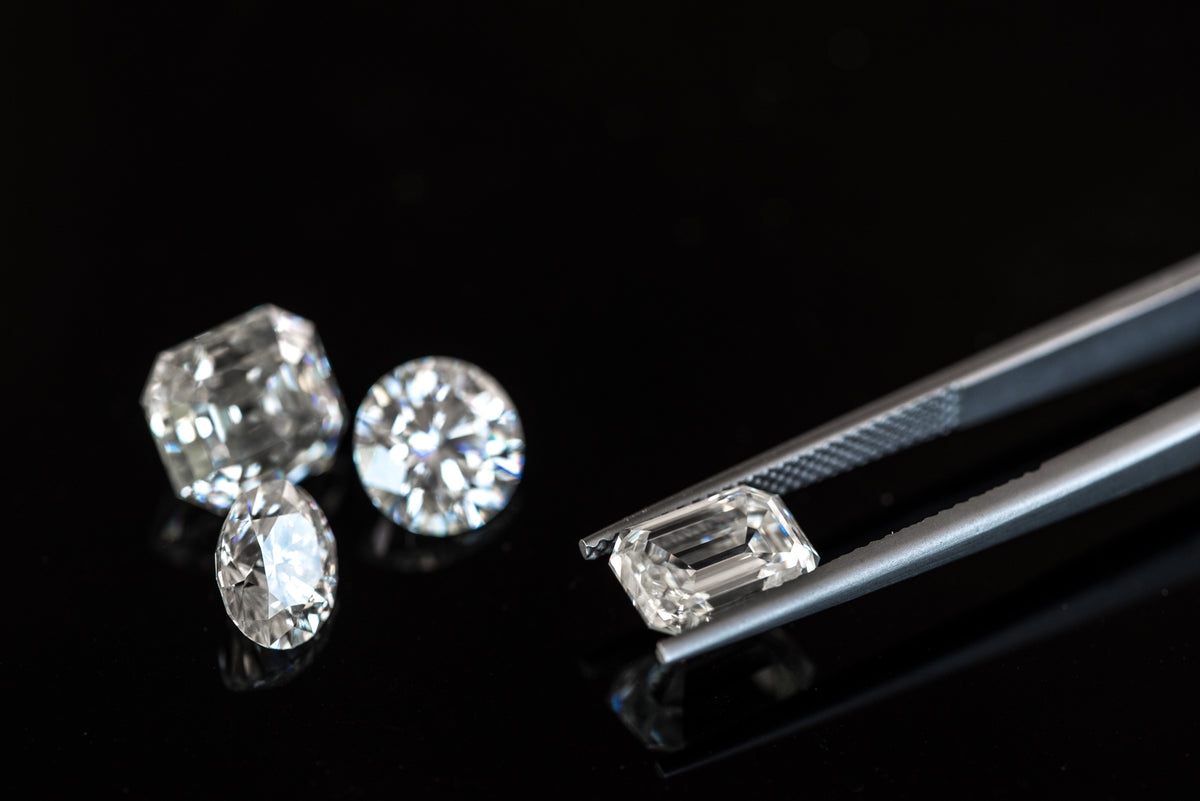
Natural Diamond, Lab-Grown Diamond, Moissanite, or Simulated Diamond: Which Is Right for You?
Choosing a center stone used to be relatively straightforward.
If you wanted a diamond engagement ring, you chose a diamond.
Today, you have considerably more options.
You can choose a natural diamond formed within the earth billions of years ago. A lab-grown diamond with the same essential chemical and physical properties. Moissanite, a distinct gemstone known for its exceptional brilliance and durability. Or a simulated diamond designed to offer the appearance of a diamond at a different price point.
More options are a good thing—but they can also make the process feel unnecessarily complicated.
The truth is that there is no universally “best” choice.
Each stone offers something different. The right one depends on what matters most to you: rarity, origin, appearance, size, durability, price, or simply the feeling you get when you look at it.
This guide will help you understand the differences so you can make that decision with confidence.
The Quick Comparison
| Natural Diamond | Lab-Grown Diamond | Moissanite | Simulated Diamond | |
|---|---|---|---|---|
| What is it? | A naturally formed diamond | A real diamond grown in a controlled environment | A gemstone made of silicon carbide | A material designed to resemble diamond |
| Is it a diamond? | Yes | Yes | No | No |
| Origin | Formed within the earth | Created in a laboratory | Almost always lab-created for jewelry | Varies by material |
| Hardness | 10 on the Mohs scale | 10 on the Mohs scale | Approximately 9.25 | Varies |
| Appearance | Classic diamond brilliance | Classic diamond brilliance | More intense fire and color flashes | Varies by material |
| Rarity | Naturally limited | Can be produced | Can be produced | Can be produced |
| Typical price | Highest | Generally lower than natural | Generally lower than diamond | Usually the lowest |
| Resale market | More established, though never guaranteed | Generally limited | Generally limited | Generally limited |
The chart is useful, but the decision is more personal than a list of specifications.
Let's look at what each option actually offers.
Natural Diamonds
Natural diamonds formed deep within the earth under extraordinary heat and pressure.
Many began forming billions of years ago before eventually being brought closer to the earth's surface through geological activity. Their individual characteristics—their inclusions, color, crystal growth, and size—developed naturally over immense periods of time.
That history is a significant part of their appeal.
A natural diamond is not simply a bright, durable gemstone. For many people, it represents rarity in a way that cannot be recreated on demand.
Why Choose a Natural Diamond?
You may be drawn to a natural diamond if you value:
-
Geological rarity
-
Natural origin
-
The history and age of the stone
-
The traditional diamond market
-
A more established secondary market
-
The idea of owning something created entirely by nature
Natural diamonds are generally the most expensive option when comparing similar sizes and qualities.
That additional cost does not necessarily mean they are “better” than every alternative. It reflects, in part, the rarity and limited supply of naturally occurring diamonds.
For some people, that rarity is central to the meaning of the ring.
For others, it is simply not where they want to spend their budget.
Both perspectives are valid.
Lab-Grown Diamonds
A lab-grown diamond is a real diamond.
It has the same essential chemical composition and crystal structure as a natural diamond. It has the same hardness and is capable of the same brilliance and durability.
The difference is where it came from.
Rather than forming naturally beneath the earth over geological time, a lab-grown diamond is created using technology that allows diamond crystal to grow in a controlled environment.
Once cut and polished, a lab-grown diamond and a natural diamond can appear remarkably similar.
Why Choose a Lab-Grown Diamond?
Lab-grown diamonds are often appealing to buyers who want:
-
A genuine diamond
-
More size within their budget
-
Higher color or clarity specifications for a similar price
-
The appearance and durability of diamond without the cost associated with natural rarity
For many people, lab-grown diamonds create more flexibility.
The budget that might purchase a one-carat natural diamond could potentially allow for a significantly larger lab-grown diamond or leave more room in the budget for an elaborate setting.
The tradeoff is that lab-grown diamonds exist in a different market.
As production technology has advanced and supply has increased, prices have changed considerably. Lab-grown diamonds generally have a more limited resale market and should be purchased because you love the stone—not because you expect it to hold a specific financial value.
If what matters most to you is owning a real diamond while maximizing your budget, lab-grown can be an excellent choice.
Moissanite
Moissanite is not a diamond.
It is a distinct gemstone made of silicon carbide.
Naturally occurring moissanite is exceptionally rare, which is why virtually all moissanite used in jewelry today is created in a laboratory.
Although it is lab-created, it should not be confused with a lab-grown diamond.
They are entirely different materials.
Moissanite is exceptionally durable and has its own distinctive way of handling light.
Why Choose Moissanite?
Moissanite may be especially appealing if you want:
-
Significant visual size for your budget
-
Exceptional durability
-
Intense sparkle
-
A gemstone that is visually similar to diamond but distinctly its own
-
More flexibility to invest in the setting or other aspects of the ring
Moissanite has a higher refractive index than diamond, which means it tends to produce more fire—or flashes of spectral color.
Some people love this extra brilliance.
Others prefer the more balanced combination of brilliance, fire, and contrast associated with diamond.
Neither is better. They simply look different.
The difference can become more noticeable in larger stones, so if you are considering a substantial center stone, it is worth looking at both before making a decision.
A Note About “Carat Equivalent”
Moissanite is often described using diamond-equivalent sizes.
A “2-carat equivalent” moissanite generally refers to a stone with approximately the same physical dimensions as a 2-carat diamond—not necessarily the same literal weight.
When comparing diamond and moissanite, millimeter measurements are often more useful than carat weight.
An 8 × 6 mm oval will have approximately the same physical footprint on your finger regardless of whether it is diamond or moissanite, even though the stones are different materials with different densities and actual weights.
Simulated Diamonds
A simulated diamond is not one specific gemstone.
It is a broad term used for stones designed to resemble the appearance of a diamond.
The material may vary.
Cubic zirconia is one of the most familiar examples, but other materials can also be used as diamond simulants.
Unlike a lab-grown diamond, a simulated diamond does not have the same chemical composition or crystal structure as diamond.
Unlike moissanite, “simulated diamond” does not necessarily tell you exactly what material the stone is made from.
This is why it is always important to ask.
Why Choose a Simulated Diamond?
A simulated diamond may be the right choice if you:
-
Want a diamond-like appearance at the lowest possible price
-
Prefer to spend your budget on solid gold, craftsmanship, or design
-
Want a larger visual presence without investing in a larger center stone
-
Simply like the appearance and understand exactly what material you are purchasing
The quality and durability of simulated diamonds can vary significantly depending on the material.
A stone intended for occasional fashion wear may perform differently over time than one chosen specifically for an everyday engagement ring.
Knowing the exact material allows you to make an informed decision about durability, care, and long-term expectations.
Why We Offer Simulated Diamonds
At Prairie Sky, we don't view simulated diamonds as a reason to compromise on quality.
The quality of a simulated diamond can vary significantly depending on the material, cut, and overall manufacturing process, which is why we are intentional about what we source. We select the highest-quality simulated diamonds available to us—stones chosen for their brilliance, clarity, durability, and overall appearance.
A lower price point should not mean settling for a stone that looks dull, poorly cut, or obviously artificial.
Our simulated diamonds are selected to offer the same sense of beauty and presence you expect from a fine piece of jewelry while making certain sizes and designs more accessible.
We believe you should be able to choose the stone that makes sense for your budget without sacrificing the craftsmanship or care that goes into the finished ring.
The material may be different, but our standards for how the finished piece looks—and how it is made—remain the same.
How Do They Compare in Appearance?
All four options can be beautiful.
But they do not all look exactly alike.
A natural diamond and a lab-grown diamond have the same fundamental optical properties because both are diamond.
Moissanite handles light differently, typically producing more intense flashes of color.
Simulated diamonds vary depending on their composition. Some may closely resemble diamond when new, while others may show more noticeable differences in brilliance, color, or appearance over time.
If your primary concern is achieving the specific visual appearance of a diamond, a natural or lab-grown diamond will offer that most directly.
If you are open to a stone with its own personality, moissanite may offer an entirely different kind of brilliance.
And if your priority is simply the appearance of a large, bright stone within a limited budget, a simulated diamond may be worth considering—as long as you understand what you are buying.
How Do They Compare in Durability?
For an engagement ring intended to be worn every day, durability matters.
Natural Diamond: 10 on the Mohs scale
Lab-Grown Diamond: 10 on the Mohs scale
Moissanite: approximately 9.25 on the Mohs scale
Simulated Diamonds: varies by material
Natural and lab-grown diamonds offer the highest resistance to scratching because they are the same material.
Moissanite is also exceptionally hard and well suited for everyday wear.
Simulated diamonds can vary considerably. Some materials may scratch, abrade, cloud, or show wear more easily than diamond or moissanite.
Hardness is not the only part of durability, however.
A stone can be difficult to scratch and still be vulnerable to chipping or fracture under the right conditions. The shape of the stone, its inclusions or internal characteristics, and the setting protecting it all matter.
A well-designed setting is just as important as the material you choose.
How Do They Compare in Size?
This is where carat weight can become misleading.
Natural and lab-grown diamonds can be compared directly by carat weight because both are diamond.
A one-carat natural diamond and a one-carat lab-grown diamond weigh the same.
Moissanite and simulated diamonds are different materials with different densities.
That means a stone of the same physical dimensions may not have the same literal weight.
When comparing different materials, look first at the stone's millimeter measurements.
For an oval, you might compare:
10 × 8 mm
rather than simply asking whether each stone is “2 carats.”
The dimensions tell you how much physical space the stone occupies on the finger.
The carat number tells you how much it weighs.
Those are not always the same thing.
How Do They Compare in Price?
Price is often the most obvious difference between these options.
In general:
Natural diamonds are typically the most expensive because of their rarity and position in the diamond market.
Lab-grown diamonds are generally less expensive than comparable natural diamonds and can offer significantly more size or higher specifications within the same budget.
Moissanite is generally less expensive than diamond and can offer substantial visual size at a lower price.
Simulated diamonds are often the least expensive, although prices vary depending on the material and quality.
There is no universally correct way to allocate your budget.
Some people would rather invest heavily in a natural diamond and keep the setting simple.
Someone else may prefer a larger lab-grown diamond.
Another person may love a large moissanite and choose to invest the remaining budget in a beautifully crafted gold setting.
A fourth person may choose a simulated diamond because they simply do not want to spend thousands of dollars on a center stone.
The right budget is the one that makes sense for you.
What About Long-Term Value?
It is best not to purchase any of these stones primarily as a financial investment.
Retail jewelry prices and resale prices are not the same thing.
Natural diamonds generally have a more established secondary market than lab-grown diamonds, moissanite, or most simulated diamonds. However, resale value is never guaranteed and depends on factors including the specific stone, its quality, market conditions, and how it is sold.
Lab-grown diamond prices have changed significantly as technology and production have expanded, which can make long-term value difficult to predict.
Moissanite and simulated diamonds generally have limited resale markets.
The most practical approach is to purchase the stone you want to wear.
If future value is important to you, talk with your jeweler about that specifically—but do not assume that a higher purchase price automatically means a guaranteed return later.
So, Which One Is Right for You?
The answer depends on what you value most.
Choose a Natural Diamond If...
You love the idea of a stone formed naturally within the earth and value its rarity, history, and traditional place in fine jewelry.
Choose a Lab-Grown Diamond If...
You want a real diamond but would prefer to maximize size, color, clarity, or overall value within your budget.
Choose Moissanite If...
You love exceptional sparkle, want a durable stone with significant visual size, and appreciate moissanite for what it is—not simply as an imitation of diamond.
Choose a Simulated Diamond If...
Your priority is achieving a diamond-like appearance at a lower price point, and you understand the specific material, durability, and care requirements of the stone you are choosing.
Our Advice
Try not to begin with the question:
Which one is best?
Begin with:
What matters most to me?
Do you care deeply about natural origin?
Is owning a real diamond important to you?
Would you rather have a larger stone than a rarer one?
Do you love intense, colorful sparkle?
Is your budget better spent on the craftsmanship and design of the ring?
There is no wrong answer.
A natural diamond can be extraordinary. So can a lab-grown diamond. Moissanite can be breathtaking. And a simulated diamond can be the right choice for someone whose priorities lie elsewhere.
The important thing is understanding the difference.
Once you know exactly what each stone offers, the decision becomes much simpler.
Choose the one that gives you the combination of beauty, durability, meaning, and value that feels right for your ring—and for the life you plan to wear it through.